One of the most exhausting things in life is a conflictual relationship—whether at work, in families, friendships, partnerships, institutions, or even online. All of us have lived through this. Such relationships expose us to a reality we’d rather not experience. Yet, there it is, and we are somehow forced to deal with it.
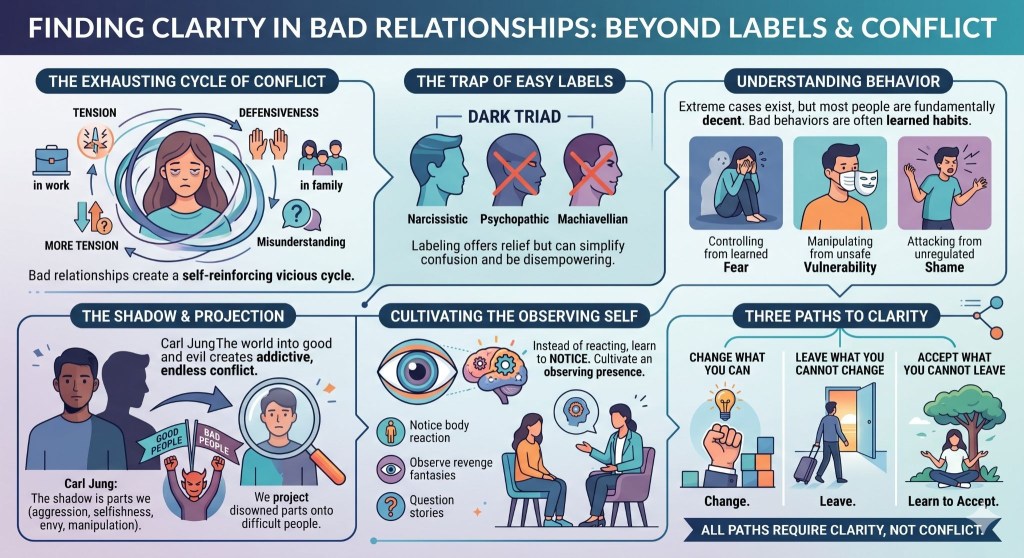
When conflicts go unresolved for a long time, a self-reinforcing vicious cycle is created: tension breeds defensiveness, defensiveness fosters misunderstanding, and misunderstanding generates more tension. Caught in this cycle, we lose our perspective and begin reacting reflexively instead of remaining observant. It can even get to the point where we become tempted to label people we are in conflict with as belonging to the so-called “dark triad”: narcissistic, psychopathic, machiavellian.
Labels and the shadow
At first, such labels can feel relieving because they offer an explanation for pain and simplify confusion. But they can also be deeply disempowering—perhaps because, outside of truly extreme cases, these labels don’t reflect the entire reality and oftentimes we sense that..
The problem with these labels is not that they are scientifically meaningless. The “dark triad” is a real psychological construct developed to study severe antisocial traits and extreme forms of violence. It has contributed important understanding to psychology and psychiatry.
But the keyword here is extreme. If most human beings would operate from psychopathy or malignant narcissism, societies would collapse very quickly as you could read either in Moral Origins: The Evolution of Virtue, Altruism, and Shame by evolutionary anthropologist Christopher Boehm or in Humankind by historian Rutger Bregman In reality, research consistently suggests something much simpler and more hopeful: fundamentally most people are quite decent. We even have the so-called the light triad, in psychology.
What is more likely is that some bad behaviors have been learned, repeated, reinforced, and eventually turned into habits. We know that habits can be hard to change especially when they form during childhood. What complicates the situation even more, acting habitually can be very pleasant. Some people become controlling because they learned to use it to avoid fear. Others manipulate because vulnerability once felt unsafe. Some attack because they never learned how to regulate shame. To be clear, harmful behavior remains unacceptable. Some people are genuinely very bad, and some relationships are deeply destructive.
However, reducing people to monsters creates another problem: it blinds us to ourselves. Once we divide the world into “good people” and “bad people,” we enter a seductive psychological territory—us versus them, light versus darkness, innocent versus evil. And strangely, this often awakens the very thing we believe we are fighting. We become consumed by the need to expose, punish, defeat, or destroy the perceived evil in the others. Conflict becomes endless because conflict itself becomes emotionally rewarding. It is addictive. And like most addictions, the relief it offers is brief and demands more the next time
As we become blind to ourselves we stop noticing our own “shadow”. Carl Jung described the shadow as the parts of ourselves we repress, deny, or refuse to identify with. Most of us inhibit aggression, selfishness, envy, cruelty, or manipulation to some extent. We prefer to think of ourselves as rational and good. Yet those rejected tendencies do not disappear; they move underground.
In everyday, messy relationship friction, we often project these disowned parts onto the other person. Our own inhibited dark behaviors get a new life as they are spotted on the other person, dramatically magnifying the conflict. Once again, to be clear, this is not about genuine abuse—when dealing with truly destructive behavior, your fear or anger is a healthy mechanism of self-preservation, not a projection. But in ordinary conflicts, the more unconscious our projection, the more intense the battle becomes.
This is why psychological clarity matters. Without self-observation, we risk becoming trapped in reactive patterns that mirror the very toxic behaviors we claim to oppose, or failing to distinguish between genuine danger and a simple difference of opinion.
What can we do?
First: notice.
Notice what happens in your body when conflict appears. Notice the fantasies of revenge, righteousness, superiority, helplessness, collapse. Notice how quickly the mind constructs stories about who is good and who is dangerous. And when you notice, you engage your prefrontal cortex which is your most useful brain area when it comes to decision making.
This is not easy because the brain is caught in the survival loop and calling in the brain areas that enable you to observe what’s happening are silenced. In emotionally charged situations, observation can feel almost impossible. Yet when the conflict cools down we do have a chance to observe. And we can start cultivating an observing ourselves during periods of calmness. This changes everything.
Sometimes we cannot do this alone. A therapist, a coach, or a trusted guide can temporarily become that observing presence for us. Through being observed without judgment, we slowly learn how to observe ourselves.
And from there, difficult decisions become clearer and we can go the old time wisdom that says:
- Change what you can change.
- If you cannot change it, leave it.
- And if you cannot leave it, learn to accept it.
None of these paths are easy. But all of them require clarity more than conflict.

