
We’ve all been there: You start the week with a clear plan to eat healthy, stay calm during meetings, and hit the gym after work. But then, a deadline shifts, your boss sends an urgent email or riles you, and your car won’t start. Suddenly, you’re on the couch with a pizza, a bag of chips and a questionable relationship with your remote, wondering where your willpower went.
If you feel like a “different person” under stress, you’re actually right—and no, it’s not an evil twin. Recent research in neuroscience shows that stress physically reshuffles the hierarchy of your brain, shifting power from the “Executive brain” which enables pragmatic, logical and goal-oriented behavior, to the “Autopilot brain” which brings in the automatic habitual behaviors. (see original research here)
For those interested in personal growth and life coaching, understanding this biological “flip” can be helpful to moving from frustration towards a change in habit.
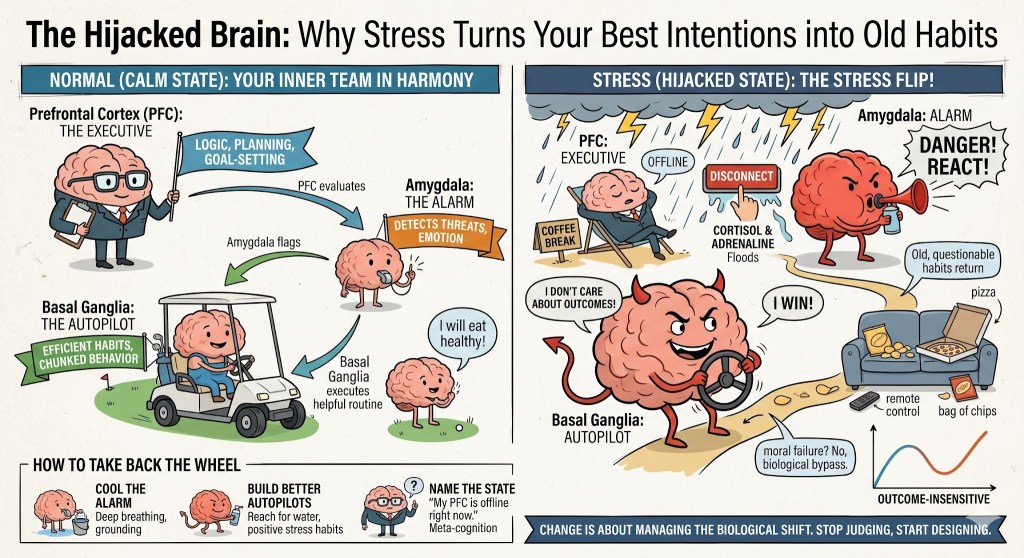
The Three Players on Your Inner Team
To understand behavior, we have to look at the “Big Three” brain regions:
- The Prefrontal Cortex (PFC) – The Executive: Located right behind your forehead, this is the center of logic, planning, and impulse control. It’s the part of you that sets goals and says, “I won’t eat that cookie because I want to be healthy.” (original article here)
- The Amygdala – The Alarm: This tiny, almond-shaped structure is your early warning system. It detects threats and processes raw emotions like fear and anxiety.
- The Basal Ganglia – The Autopilot: This deep-brain hub is the home of habits. It “chunks” behaviors together so you can do them without thinking—like driving a car or brushing your teeth. (original research here)
The Stress Flip
In a perfect world, these three work in harmony. The Amygdala flags a problem, the PFC evaluates it logically, and the Basal Ganglia executes a helpful routine.
However, stress flips the switch. When stress hormones like cortisol and adrenaline flood your system, they act like a “disconnect” button for the PFC. The “Executive” effectively goes on an unscheduled coffee break, leaving no one in charge of the logic.
With the logical PFC weakened, the Amygdala becomes hyper-responsive, making you feel more reactive and anxious. At the same time, the Basal Ganglia takes over the steering wheel. This is why, under stress, we don’t make new, creative choices; we fall back on our deepest, oldest habits—even they are not useful anymore.
Willpower Isn’t Enough
Habitual behavior under stress isn’t a sort of personal failure; it is very often a biological bypass which we may be able to influence.
Research suggests that under pressure, some of us may become “outcome-insensitive.” (original research here and here). This means even if you know that a second glass of wine will make you feel like a discarded dishcloth tomorrow, your Basal Ganglia doesn’t care. It only knows that in the past, wine provided a quick hit of relief. Since the PFC isn’t there to argue, the habit wins.
How to Take Back the Wheel
If stress makes the “executive” go on vacation, how do we get it back to work?
- Cool the Alarm: Techniques like deep breathing or “grounding” – (see here a good resource for grounding) send a signal to the Amygdala that the threat has passed. This lowers the chemical “noise” and allows the PFC to reconnect.
- Build Better “Autopilots”: Since we know the Basal Ganglia will take over during stress, the goal is to make your “stress habits” healthy ones. By practicing a positive habit (like reaching for water instead of soda) when you are calm, you “program” the Basal Ganglia so that it has better routines to fall back on when things get hectic.
- Name the State: Simply acknowledging, “My PFC is offline right now,” can help. This “meta-cognition” is a PFC-heavy task that can help jumpstart the logical brain.
The Bottom Line
Change is about managing the biological shift between your logical mind and your habitual brain. By understanding that stress pushes you toward your “autopilot,” you can stop judging your past choices and start designing a life that accounts for how your brain actually works. And this is the way to our deepest values, which I will touch on in a different post.
 Step by step with Diana