On social media, I often run into claims that the brain is endlessly plastic and therefore we can change anything about ourselves with enough effort. These claims are seductive because they tap into our constant dreams of change—the hope that we could be better, learn more, or finally fix our flaws if we just tried hard enough. This desire for a better life comes from a deep, archetypal place, and it’s only natural that the commercial world takes advantage of it. But since I do know a thing or two about the brain I want to shed some light on brain plasticity and some surprising recent research on how to bring back early life plasticity.
Brain plasticity over time and coaching
Yes, the brain is plastic, but that’s saying so little. The truth is that it is not as plastic in adulthood as many would like it to be, especially when it comes to fundamental changes to old habits (Hensch, 2005; Balleine & O’Doherty 2010; Smith & Graybiel, 2014). While the brain is plastic in so many different ways, here I will focus on early life brain plasticity. It is the foundation for almost everything we end up doing as mature individuals. But before that, let’s look at what we are dealing with in adult life, regarding plasticity.
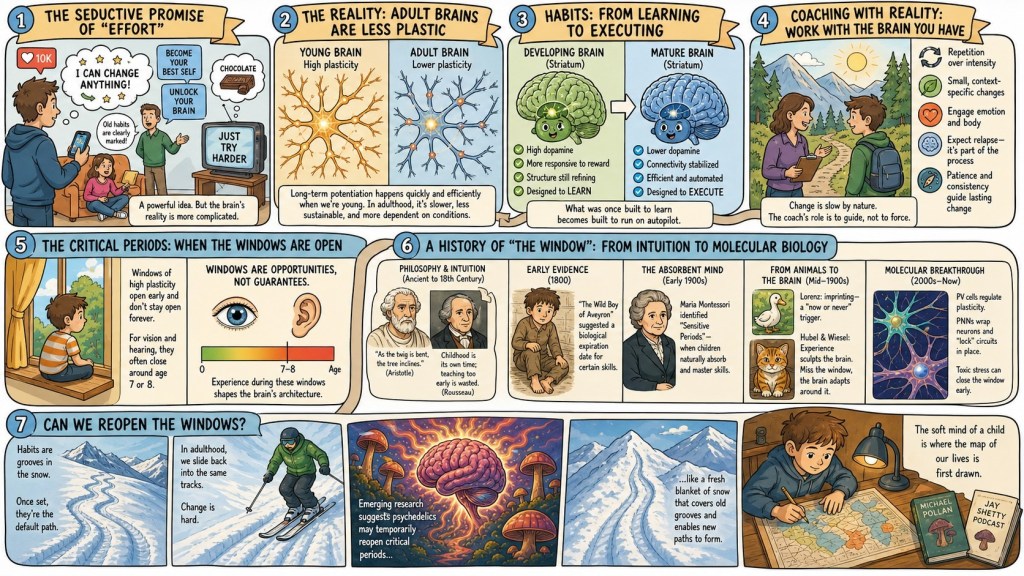
Studies in animals, in a brain area called hippocampus, show that a form of plasticity called long-term potentiation —the cellular process often linked to learning—is not absent in older brains, but it is altered. It is less sustainable, sometimes unprecise, and more dependent on external conditions. In young brains, long-term potentiation happens quickly and efficiently. In older brains, it requires more support, and even then, it is more fragile (Ryan, 2015; Drulis-Fajdasz, 2015; Ferando, 2016; Hullinger 2016).
Even in the basal ganglia, and particularly in the striatum which is involved in habit formation, there is evidence that plasticity is not the same across the lifespan. During development, this system is more responsive to reward, more heavily modulated by dopamine – the molecule involved in motivating our behaviors, and still undergoing structural refinement (Lovinger, 2011; Calabresi 2007; Perrin 2018) . These conditions favor learning. With maturation, dopamine receptor levels decline, connectivity stabilizes, and the system shifts toward efficiency and automation (Sturman, 2012; Larsen, 2020; Simon, 2014). What was once a circuit designed to learn becomes a circuit designed to execute—making change possible, but considerably harder.
Recognizing this reality—that the adult brain is far less plastic than it once was, and that change is therefore inherently difficult— is essential for effective coaching. Without this understanding, both the coach and the client are likely to misinterpret slow progress as failure, rather than as the natural pace of biological change. When we take this into account, the goal shifts from forcing rapid transformation to creating the right conditions for gradual rewiring. This means working with repetition rather than intensity, focusing on small, context-specific changes, and engaging not just cognition but also emotion and the body. It also means anticipating relapse into old patterns, especially under stress (see my blog post), and treating it as part of the process rather than a setback. In this sense, successful coaching is less about pushing harder, and more about patiently and consistently guiding the brain toward new patterns.
The Critical Periods: When the Windows Are Open
The strongest brain plasticity and flexibility occurs during distinct time windows known as critical periods. Deep down, we knew this long before we had the research to prove it. Why else would we send children to school? There is a collective intuition that there are specific “windows” into development that don’t stay open forever.
For example, for systems like vision and hearing, these windows often begin to shut around age 7 or 8, having finished their job of fine-tuning our neuronal circuits based on what we saw and heard in those first few years.
A History of “The Window”
The story of these windows is a fascinating journey from ancient intuition to modern molecular biology. It started with the “Blank Slate” or Tabula Rasa—an idea famously held by Aristotle, who believed the earliest “imprints” on a mind were the ones that lasted. It’s the philosophical version of the proverb, “As the twig is bent, the tree inclines.” Later, Enlightenment thinkers like Rousseau argued that childhood was its own unique state; he essentially warned that trying to teach a child before they are “ready” is a wasted effort. But the first “hard” evidence was tragic: the case of the “Wild Boy of Aveyron“ in 1800. His inability to fully master speech after years of isolation suggested a “biological expiration date” for certain skills. By the early 20th century, Maria Montessori gave us the beautiful term “The Absorbent Mind,” identifying “Sensitive Periods”—specific blocks of time when a child is driven to master a skill. If the stimulus is missing during that time, the opportunity for easy mastery simply vanishes.
From Philosophy to Biology
In the mid-20th century, the idea moved decisively from the nursery to the lab. Konrad Lorenz observed geese “imprinting” on the first moving thing they saw—establishing a “now or never” biological trigger. Then came the 1960s, when Hubel and Wiesel showed that if a kitten’s eye was covered during a specific window, the visual cortex would physically rebuild itself to ignore that eye. It was proof that our environment literally carves itself into our biology.
A few years back, we reached a molecular breakthrough. We now know that these windows are actively opened and closed by “chemical brakes.” Cells called Parvalbumin (PV) control the plasticity, while Perineuronal Nets (PNNs) act like physical scaffolds that wrap around neurons, locking them into their adult form. This is why researchers like Pat Levitt advocate so strongly for early intervention. If a child experiences “Toxic Stress”—like poverty or abuse—it can cause these molecular “locks” to close prematurely, hardening the brain before it has had a chance to build a healthy foundation.
Even ancient societies seemed to understand this “biological apprenticeship.” They saw skills like tracking or language as things that had to be mastered while the mind was still “soft.” Even Rites of Passage (usually around puberty) were essentially social markers that happened just as the brain’s molecular brakes began to harden the structure for adulthood.
Can We Reopen the Windows?
I recently heard a beautiful way to visualize this from Mendel Kaelen: imagine our habits and brain networks as forming “grooves” in the snow on a mountain. Once those grooves are set during childhood, they become the default path. In adulthood, we find ourselves sliding back into those same tracks, no matter how hard we try to steer away .
This is why what we learn in childhood is so important, particularly regarding trauma. Resolving trauma isn’t necessarily about “negative feelings” toward an unsupportive environment; it’s about identifying these deeply ingrained patterns and aiming to change them. But as we all know, that rarely happens overnight.
Interestingly, new research is looking into whether certain substances, like psychedelics, could potentially reopen these critical periods (Nardou, 2019; Nardou, 2023). Using the mountain metaphor, psychedelics might act like a fresh blanket of snow, covering the old grooves and enabling the brain to form new ways to go down the mountain .While this research is promising, it still needs to pass the test of time. For those curious about this “fresh snow” approach, the work of Michael Pollan is an excellent place to start (How to Change Your Mind – by Michael Pollan), or you can listen to his discussions on podcasts like Jay Shetty Podcast MICHAEL POLLAN: Life is Short (How to Spend It Wisely). We are still learning, but one thing is clear: the “soft” mind of a child is where the map of our lives is first drawn.

