
Coaching is either an ancient Greek philosophy or a forty-year-old profession, depending on who you ask at a networking event. It’s actually a funny story of how a word for a wooden box on wheels, albeit a beautiful one, became a job title for people who help you reach your potential without actually driving you anywhere.
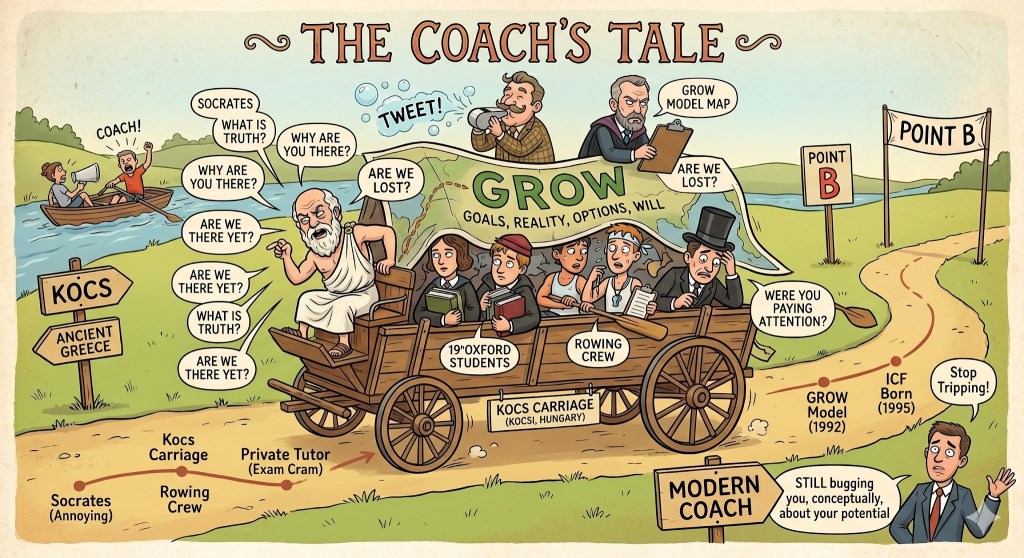
Socrates: The Original (and Annoying) Coach
Socrates was wandering around Ancient Greece asking everyone annoying questions. He called his method “midwifery,” meaning he wanted to help people “give birth” to their own ideas. This idea—that you actually have the answers and the coach just bugs you until you find them—is still the core of the whole industry. I must say, I’m not that sort of annoying coach. I only ask questions when I sense it’s the right to ask them. But the methods of socratic questioning are used in coaching and it’s well described here.
A Shout-out to Kocs, Hungary
The actual word “coach” comes from a 15th-century Hungarian village called Kocs. The locals built a fancy horse-drawn carriage called the kocsi. By the 16th century, the English borrowed the word to describe a vehicle that took important people from Point A to Point B. Today, coaches do the same thing, although in a more conceptual way. Some coaches actually do use horses in their practice, but I wouldn’t know that works.
From Exam Cramming to Sweaty Rowing
In the 1830s, Oxford mathematical students used “coach” as slang for private tutors who “carried” them through their grueling exams. Eventually, the term moved to the river, describing people who yelled at rowing crews, and finally became the standard name for anyone with a whistle and a clipboard.
The 80s: Big Goals
The modern coaching era exploded in the 1980s when guys like Thomas Leonard and Sir John Whitmore decided to mix business with sports psychology. In 1992, Whitmore developed the GROW model, which gave everyone a map to follow. By 1995, the International Coach Federation (ICF) was born, aiming to make coaching a real profession.
Nowadays, coaching keeps changing, but it still relies on that old Socratic promise: that you’ve got the goods inside you, and a coach is just there to help you stop tripping over your own feet.

